Net Metering 3.0 & Utility Solar Buyback Rates Explained (2026 Homeowner Guide)

"When utilities slash solar export credits from retail rates down to wholesale pennies, the winning move is simple: stop giving your midday solar power away to the utility—store it in an LFP battery and use it yourself at 6 PM." — 2026 Market Analysis by Juliet D.
What Is Net Metering (and Why Utilities Are Changing the Rules)?
Net Energy Metering (NEM) is the billing mechanism that credits homeowners for excess solar electricity sent back to the utility grid during sunny midday hours. Historically, under 1:1 Retail Net Metering, every kilowatt-hour (kWh) you exported at noon earned a full 1-for-1 credit against a kilowatt-hour you pulled from the grid at night.
In 2026, U.S. states fall into three distinct utility solar billing regimes. Knowing which regime applies to your state determines whether you should install solar-only or solar + LFP battery storage.
| Billing Model | How Export Credits Work | Example States | Optimal 2026 System Design |
|---|---|---|---|
| 1:1 Retail Net Metering | 1 kWh exported = 1 kWh retail bill credit | FL, PA, NJ, MA, OH | Solar-Only (or Battery for Blackouts) |
| Time-of-Use (TOU) / Avoided Cost | Exports credited at 60%–80% of retail or TOU tier | AZ, NC, IL, UT | Solar + 10–13.5 kWh LFP Battery |
| NEM 3.0 / Net Billing / Deregulated | Midday exports worth 4¢–8¢; evening peak 35¢–55¢+ | CA (PG&E/SCE/SDG&E), TX (ERCOT), HI | Solar + 13.5–27 kWh Self-Consumption Battery |
How Self-Consumption Beats NEM 3.0
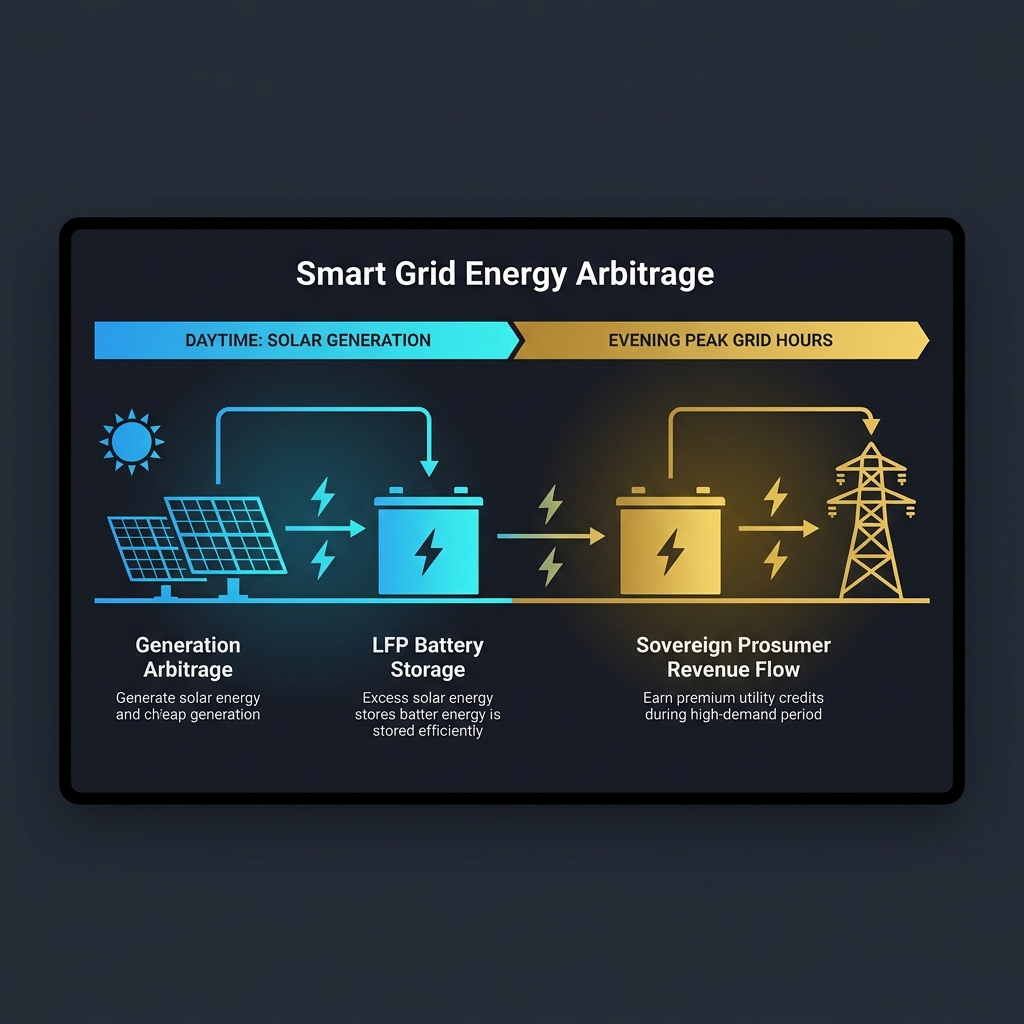
Under California's NEM 3.0 (Net Billing Tariff) and many Texas retail electric plans, utilities buy your midday solar power for 5¢ to 8¢/kWh and sell it back to you between 4 PM and 9 PM for 32¢ to 58¢/kWh. If you install solar panels without a battery in those markets, you lose up to 75% of the value of your exported electricity.
When you pair your panels with an LFP battery (see our Grid-Shift Arbitrage Guide), your smart inverter automatically stores your midday surplus instead of exporting it for pennies. At 4 PM, your home switches to battery power—eliminating expensive peak-rate utility purchases entirely.
Bonus Revenue: Peak Export Events & Virtual Power Plants
Even under NEM 3.0, utilities experience grid stress during late-summer evenings (typically August and September from 6 PM to 8 PM), when export rates spike to $2.00–$3.00+ per kWh. Homeowners with automated batteries or enrolled in Virtual Power Plants (VPPs) can discharge stored battery power during those high-value windows to generate hundreds of dollars in extra bill credits.
Frequently Asked Questions
Is solar still worth it under NEM 3.0 in 2026?
Yes—when paired with battery storage. While solar-only systems saw their payback period lengthen under NEM 3.0, solar + LFP battery systems achieve a 5.5 to 7.5 year payback because retail utility rates have risen so sharply.
Which states still have 1:1 net metering in 2026?
Many major states still offer 1:1 or near-retail net metering across major utilities, including Florida, Pennsylvania, New Jersey, Maryland, Massachusetts, New Hampshire, Minnesota, and Washington.
What is the difference between net metering and net billing?
Net metering credits your exported solar kWh at the same retail rate you pay for electricity. Net billing separates the two: you pay retail rates for grid power imported, while excess power exported to the grid is credited at a lower wholesale or avoided-cost rate.
Get Your Free National Solar Savings Estimate
Compare verified 2026 residential solar installation quotes, 30% Federal ITC eligibility, and zero-down financing options in your area.
Juliet's Final Verdict
"With utility rates climbing 6% to 11% annually across major U.S. corridors, owning your solar generation and LFP storage is the single most effective hedge for household cash flow in 2026."